How manufacturers are gearing their factories for uncertainty


Flexible production is becoming a decisive factor for automotive manufacturers in order to adapt plants more quickly to new models, technologies and fluctuating production volumes. Current projects show which strategies OEMs are using to equip their factories for this.
Five different powertrains for one model on the same assembly line. A new electric platform whose production facilities are initially tested virtually. Or an existing plant that takes on a completely new vehicle without stopping ongoing production to do so. Flexible production now means significantly more than building several variants of one model on the same line.
The reason for this is obvious. Manufacturers today have to make billion-dollar decisions on plants and production facilities, even though it is hardly possible to predict with certainty how the mix of powertrains, models and volumes will develop in the coming years. Electrification is advancing at different speeds from region to region, hybrids are regaining importance in some markets and at the same time model programmes are in some cases changing at short notice. This makes it all the more important not to commit factories too early to a single scenario.
This also shifts the understanding of flexibility. In the past, the main aim was to map as many variants as possible efficiently on one line. Today, a factory should also be able to accommodate different powertrain technologies, integrate new models with limited conversion effort and, if necessary, shift capacities between model series or locations.
No single technology is enough for that. Flexible production arises from the interaction of product architecture, plant concept, digital planning and logistics.
Five powertrains on one line
BMW in Spartanburg provides a particularly clear example. The manufacturer has invested 1.7 billion dollars in its production site in South Carolina. The new X5 there is the first BMW model that can run through a shared assembly line with five different powertrain technologies. The battery-electric iX5 is due to follow in 2026.

What is interesting here is less the number five itself than the production concept behind it. The line must be able to handle petrol, diesel, plug-in hybrids and battery-electric vehicles directly one after another. This means BMW no longer ties assembly utilisation so closely to the development of a single powertrain.
If demand shifts between the technologies, a dedicated line does not necessarily have to be ramped up or down. The production system can change the mix within a shared structure. This capability is becoming more important, especially in a phase in which markets are developing very differently.
However, it is not enough simply to install different powertrains in an otherwise unchanged vehicle. Body shop, assembly, conveyor technology, testing processes and material provision must be able to handle the different technical architectures. The retooling in Spartanburg therefore does not only involve new buildings. Tools, plant layout and maintenance were designed so that different X5 variants can be manufactured directly one after another.
Virtual 3D simulations also play a role in the conversion. Production areas can first be planned and checked digitally before the physical adaptation begins.

This is precisely where one of the central challenges of modern brownfield projects lies. Existing systems are to continue being used for as long as possible, but at the same time must remain sufficiently open to accommodate new products and processes. Instead of completely rebuilding production areas with every model change, systems are adapted, expanded or newly combined.
Flexibility thus also becomes a form of investment protection. The more product and powertrain variants a plant can master with the same basic structure, the lower the risk that a system originally designed for years will suddenly no longer fit the production programme under changed market conditions.
First convert virtually
A similar idea can be seen at Mercedes-Benz in Kecskemét. The Hungarian plant was expanded for around one billion euros and in future, in addition to the electric C-Class, is also to produce the electric GLC and, exclusively, a smaller G-Class. At full capacity, production could rise to up to 400,000 vehicles per year.

An essential part of this flexibility is created already in the planning stage. With the Digital Factory Twin, Mercedes initially maps new systems and processes virtually. Processes are simulated and possible collisions identified before the physical installation begins. Project manager Patrick Walz even describes supposedly banal cases such as a light fitting that could collide with a newly planned system.
This is crucial particularly in brownfield projects. New production volumes often have to be integrated into plants that continue building vehicles during large parts of the conversion. Errors that only become apparent during installation can quickly cost valuable production time. The more precisely conversions are played through digitally beforehand, the lower the risk that problems will only become visible during an already short production stoppage.
Digital-first line design therefore does not simply mean representing a factory in three dimensions. What is crucial is that systems, work areas and material flows can be tested and changed before the actual conversion.
The virtual factory becomes a tool that can be used to speed up real conversions and make them more reliable. BMW is also pursuing this logic at its Munich parent plant. The ramp-up of the new i3 of the Neue Klasse will take place there in 2026.
At the same time, production and logistics processes are being more closely digitally connected. This includes automated surface inspections, live tracking in assembly and a logistics system that automatically coordinates a large part of its transport orders.
Munich is a particularly interesting counterpart to new greenfield plants. The site is densely built up, located right in the middle of the city and has only limited land reserves. Flexibility here therefore does not arise from unlimited space, but from the most intelligent possible use and further development of existing production structures.

Flexibility begins with the platform
How flexible a factory can actually be later on, however, is not decided only in the plant. Some of the possibilities and limits are already determined during vehicle development.
For example, JLR is working more closely with material and production partners in the development of its vehicle platforms. In the EMA programme, manufacturing requirements were already taken into account while the vehicle architecture could still be changed.

At first, that sounds like classic design for manufacturing. However, this approach is central to later production flexibility. The earlier components, materials, tolerances and joining processes are aligned with existing or as universally usable production processes as possible, the fewer special solutions will have to be created later in the plant.
A platform strategy therefore does not only concern the shared use of components between different vehicles. It also determines how much production equipment can be shared and how complex the integration of a new model into an existing plant will be.
The more separately vehicle and production development work from one another, the higher the risk that the factory will ultimately be dependent on product-specific special systems. If, on the other hand, both areas are brought together early, flexibility can already be built into the product architecture.
This becomes particularly important when platforms are used across several plants or new models are to be moved more quickly within a production network.
New products, without stopping the line
Volvo also shows in Torslanda how closely product and production architecture are now linked. For around SEK 10 billion or approximately 1.1 billion dollars, Volvo has equipped the site, among other things, with megacasting, its own battery assembly, a modernised painting process and a revised assembly line.
Particularly noteworthy is the integration of the EX60. The new electric vehicle had to be incorporated into an existing production environment without stopping ongoing production for this.
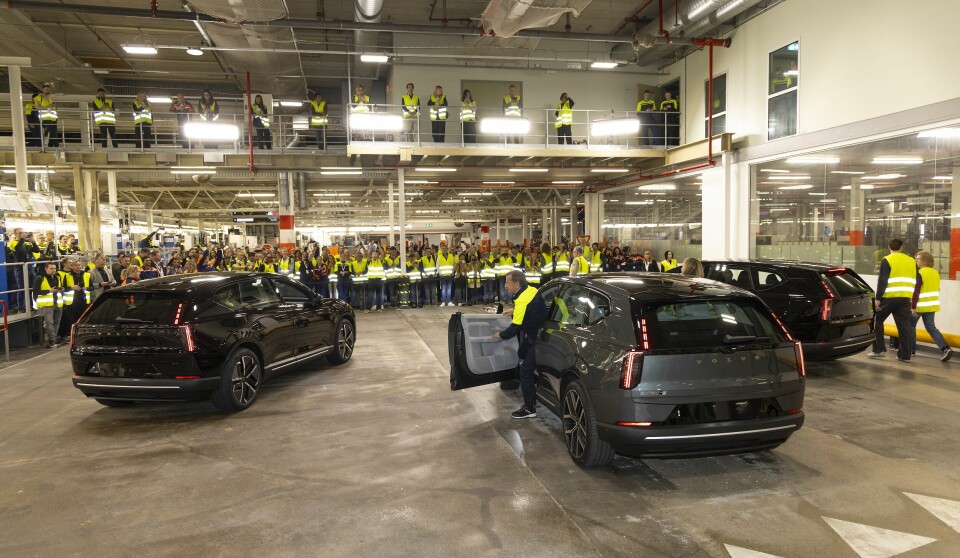
Projects like these in particular show how much the requirements for flexible plants have changed. In the past, a model change was often associated with long conversion phases and clearly separated production generations. Today, new technologies increasingly have to be integrated into existing structures while the factory continues producing in parallel.
This does not only affect the systems themselves. Material supply, maintenance, training and production control must also master the transition. A new vehicle can only be integrated flexibly if these areas are just as adaptable as the actual assembly line.
The flexible factory is not a single technology
These examples also show why Flexible Production Technologies can hardly be reduced to a specific system or a specific degree of automation.
Modular automation can reduce investment risks and facilitate conversions. At the same time, it creates new requirements for control, data integration and maintenance. The more strongly processes are interconnected, the greater the impact individual errors can have on the entire production system.
This is also why the aim is not to automate as much as possible. What is crucial is to design automation in such a way that it remains adaptable. Systems must be able to handle different variants, integrate new processes and be reused for as long as possible.
The direction is nevertheless clear. In the latest AMS/ABB survey, 29 per cent of respondents cited more flexible and more modular production processes as a measure with which they want to respond to the current cost pressure. A further 31 per cent are relying on additional automation and robotics, 26 per cent on stronger digitalisation and data integration.

That is no coincidence. Flexible production is increasingly arising from precisely this combination. Systems must become more modular, their planning more digital and their control more data-based.
At the same time, the boundary between product and production strategy is becoming more blurred. A platform that can be industrialised well facilitates later integration into the plant. A digitally planned conversion shortens the physical implementation. A flexible line can accommodate different powertrains. And logistics designed accordingly must ensure that the additional mix of variants does not end in higher inventories and greater complexity.
The future-proof factory therefore does not have to be perfectly tailored to a single vehicle. Its real strength lies in how well it can deal with changes.
Articles Chosen For You...
-

Inside the US tariff turmoil reshaping North American vehicle production
-

Idle EV Battery lines find a customer in Data Centres
-

McLaren's £500m ($675m) stake signals a new era for British carmaking
-

How VW retooled Hanover for the new Multivan
-

Why energy is now central to manufacturing cost control
-

Audi integrates A2 e-tron into existing production
-

The wiring problem automotive manufacturers can't ignore
-

Valeo puts flexibility at the heart of manufacturing
-

Has the wire harness finally become robot-ready?
-

JLR cuts 4,000 jobs to fix an underloaded plant network