Ford gears up for faster EV assembly in Louisville

The carmaker has transformed the production process for its forthcoming Fathom electric truck from one line into three parallel subassemblies, reducing complexity and driving up quality
Ford is installing a completely new production system at its at its Louisville Assembly Plant, which will make the Ford Fathom midsize electric truck in 2027. As part of a $2 billion overhaul of the plant, which began in late 2025, the carmaker says the Universal EV Production System radically simplifies the assembly process. Prototype production will begin in the first quarter of 2026, with customer models following by mid-year.

The UEV Production System transforms the traditional assembly line into an ‘assembly tree’. Instead of one long conveyor, teams simultaneously build three subassembly vehicle sections in parallel before bringing them together – the front and rear sections, and the third containing the structural battery, seats, consoles and carpeting.
The sections arrive in front of the operator as a kit, with parts in the right orientation, and fasteners, scanners and power tools included.
Ergonomic benefits

Building the three sections separately in parallel also facilitates access to the overall surface area to be worked on, enabling more operators to work at the same time, which speeds up the process. Ford says the UEV Production System removes the cumbersome restraints of working inside a frame, as seen in the example of installing a seat, where operators typically have to squeeze through the doorway and work around the structure of the vehicle with tools in hand to secure it. In the UEV Production System, the seat goes on the rear clip and gets secured in place without the vehicle structure in the way. Likewise, to install components on the dashboard, which has the most parts per section of the vehicle, operators can stand facing the front clip with a direct line-of-sight, optimising installation.
The three main sections of the body marry together only when the bulk of components are already installed. This is possible, in part, thanks to the use of large unicastings where a single large aluminium casting replaces what was once dozens of individually stamped and welded pieces to help form two of the main sections of the vehicle.
Assembly operatives have been trained at the New Model Product Development Center (NMPDC) on the new assembly method.
Faster Fathom output
Ford has redesigned specific parts of the vehicle as part of its assembly streamlining, a move that has also reduced production costs. Each unicasting is structurally whole on its own and does not to be welded into a complete body shell before work can begin inside. On the third line, interior components are installed on top of the battery, which serves as the vehicle’s floor. The battery itself is then installed into the vehicle from the bottom.
The UEV Production System and its assembly tree will allow Ford to assemble the Fathom 40% faster than LAP’s current products, and the company has reinvested some of that time into insourcing and automation to improve quality and cost. Ford says that gives LAP the highest level of automation in final assembly across all Ford plants globally. Ultimately, it means the Fathom’s assembly will net out at 15% faster than previous production times at the Louisville plant.
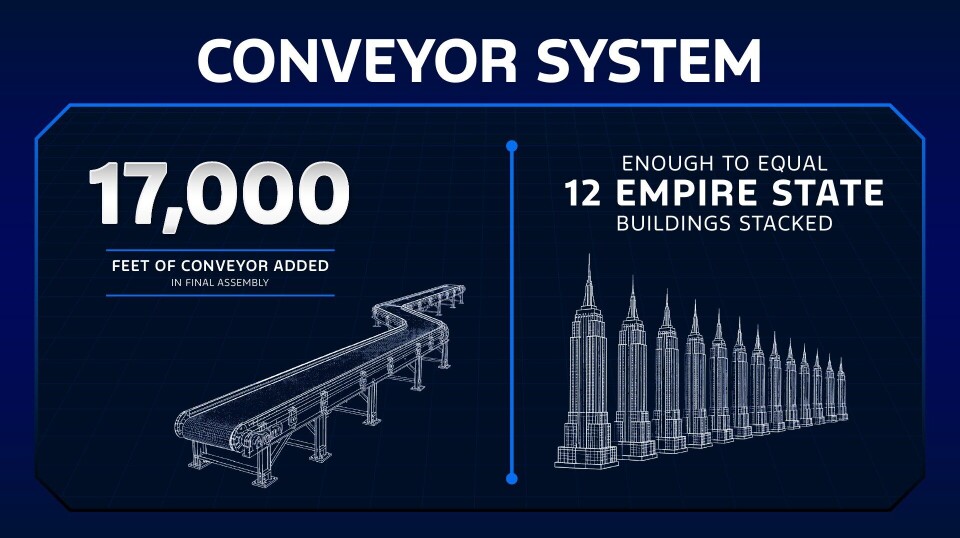
The UEV Production System features more than 5,000 metres (17,000 feet) of conveyor in final assembly and Ford has built around 21,500 sq. m (230,000 sq. ft) of concrete floor on which to stand the assembly equipment.
Module flash station
For the first time, a software module flash station will ensure vehicles have the latest software prior to module installation. Previously, this software flash happened after the vehicle was built, and if issues were detected, updates took 10 minutes per vehicle. With private 5G in the plant, operators can perform quality tests like these as a vehicle rolls down the three branches of the assembly tree.
To support this, Ford has tripled WiFi coverage at LAP from 385 to 1,080 access points to provide constant, high-bandwidth, low-latency connectivity. Network capability will be the latest-generation WiFi-7, which is more resilient and three times faster than previous generations. LAP has more access points than any other Ford plant globally. It means Ford can make more on-the-spot quality checks along the assembly tree to make the build of each vehicle more efficient.
Battery pack rethink
Ford has also been working on how to get more miles out of a smaller battery to simultaneously address the range anxiety of customers who are weighing up the pros and cons of buying an EV, while at the same time addressing the weight and cost issues of the battery itself. The average lithium battery accounts for somewhere around 40% of an EV’s total cost and upwards of 25% of its weight, according to Ford.

Alan Clarke, vice-president of Advanced Development Projects at Ford and designer of the UEV Production System, says his team approached the design engineering and manufacturing of the vehicle together from a completely new perspective. That includes equipping every engineer working on the project with what are called Bounties – numerical metrics assigned to key factors, such as vehicle mass and aerodynamic drag, that directly translate to efficiency and the range and the cost of the battery. Clarke says the aim is to reduce overall energy consumption of the vehicle as a system, not simply the optimisation of a single part.
Ford is making the lithium iron phosphate (LFP) batteries for the Fathom at BlueOval Battery Park in Michigan with technology licensed from battery supplier CATL. LFP batteries are built on a lower cost chemistry, having no nickel or cobalt content. The prismatic battery pack designed by Ford also has a very efficient cell-to-structure architecture, which turns the battery into an integral part of the truck skeleton.
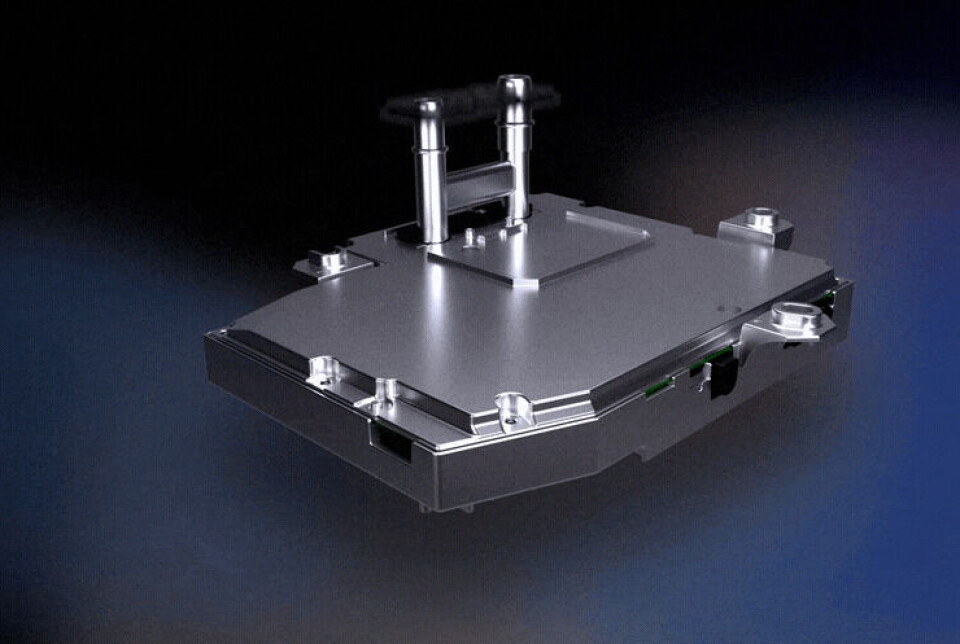
The battery pack uses a multi-layer, single piece, flexible circuit board, which integrates low and high voltage, as well as thermal sensing connections, reducing hundreds of bus bars and wires into a single part. According to Clarke, the architecture reduces non-cell cost and has a very compact, power electronics unit inside the battery pack, which eliminates extra connectors, enclosures, mass and overall volume.
Module focus
Reduced manufacturing complexity is also helping to drive up quality. The Fathom architecture has 50% fewer connections and 20% fewer parts than a typical vehicle programme. Combined with the replacement of pre-opened pre-positioned (POPP) clamps with quick connects, there is a lower risk of faulty connections.
This has helped reduce the wiring harness by more than 1,200 metres (4,000 ft) and made it almost 10kg lighter than in the first-generation electric SUV.
Ford says that the time saved using the new UEV Production System is being reinvested into insourcing and automation to improve quality and cost. The architecture of the system incorporates a five-fold increase in Ford’s own module design, providing five times more control over critical semiconductors.
Ford’s electronics team has produced 35 million Ford modules. That includes a High-Performance Compute Center unifying infotainment (IVI), the advanced driver assistance system (ADAS), audio and networking into a single, compact powerhouse.
At the same time, the team has decreased the total number of physical modules in the vehicle. This approach delivers significant cost savings of 10-15% per module.
By combining parallel assembly, a new production line architecture and a new battery pack design, Ford aims to produce the Fathom faster, at lower cost and with higher quality. Once full production is up and running in the middle of next year and plant performance is analysed, Ford will be looking at the lessons learned and what it can apply at other plants in North American and further afield.