Circular Manufacturing
Circularities: Volkswagen reverses the assembly line at Zwickau

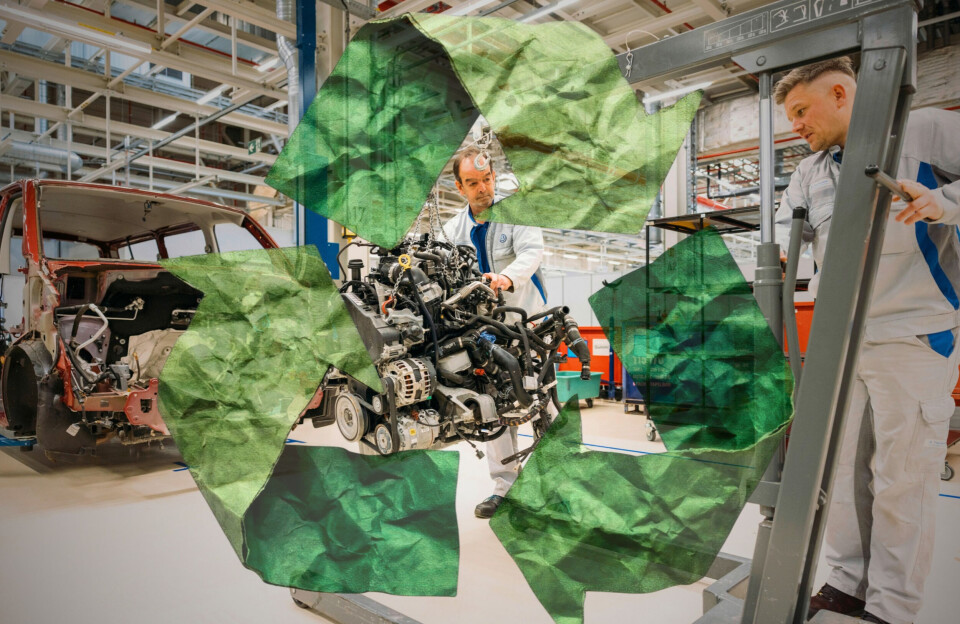
The new dismantling hub at Saxony borrows the fishbone logic of vehicle assembly and flips it, aiming to turn end-of-life vehicles into used parts, battery value, and recycled feedstock at industrial speed.
It is essentially production in reverse...
Most car plants exist to put things together as quickly as possible, but Volkswagen has just built one to do the opposite. At Zwickau, where the Group already makes electric cars, a new eight-station line takes vehicles apart with the same discipline that goes into assembling them. The hub officially opened just a few weeks ago, and it is the first practical expression of a circular strategy that has been taking shape for some time.
The strategy strikes a balance between both economic and sustainability gains. With this approach, Volkswagen sees the circular economy as a way to strengthen competitiveness, trim material costs, reduce dependence on primary raw materials while making its supply chains harder to disrupt. In an era such as ours, this comprehensive approach is prerequisite.
Recycling, remanufacturing, and second-life applications could also open up new revenue streams, and partnerships with specialists are meant to carry selected projects forward.
Andreas Walingen, Head of Group Circular Economy at Volkswagen, echoing the carmaker’s motto, describes the guiding principle as “one vehicle, three value streams, one business model”. The Zwickau line is where that slogan comes alive on the shop floor.
The decision is made before the first bolt turns
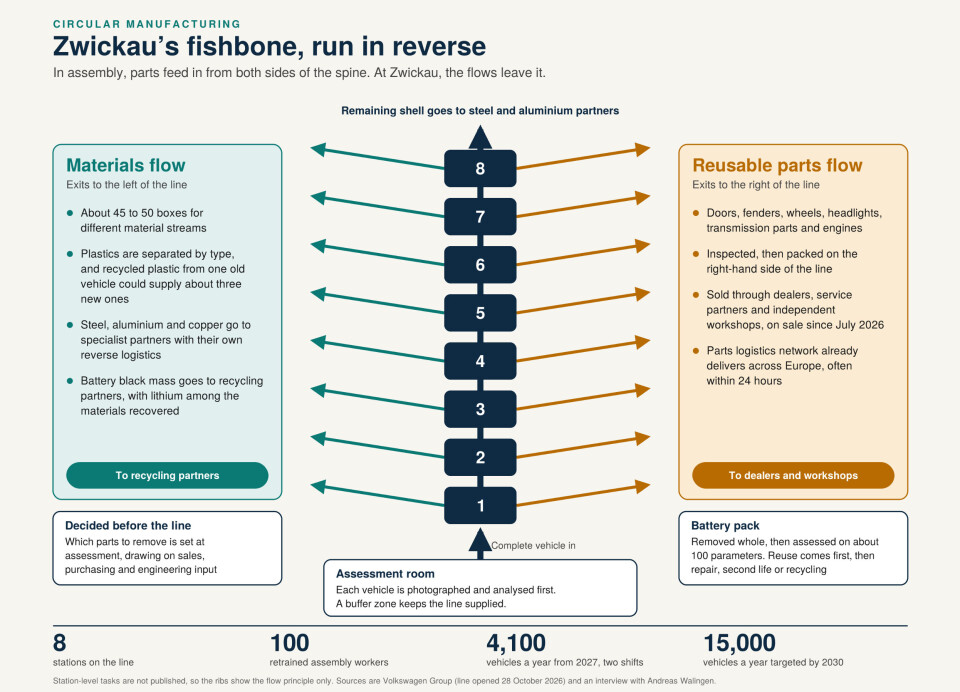
Dismantling is not, however, as homogeneous a process as assembly. Every vehicle needs to be individually examined, photographed and analysed in a dedicated room before it reaches the line. “Before dismantling begins,” says Walingen, “we carry out an analysis to establish what materials are present, which components might be suitable for reuse as used parts, and whether the vehicle contains a battery.”
From that assessment, the carmaker applies what he calls “algorithms” to judge what is indeed worth recovering. The “three value streams” are: used parts, the battery and its condition, and the materials that can be reclaimed.
A dismantling list covers all three, along with legal requirements, and some vehicles will be taken back precisely because they hold components or materials Volkswagen wants.
The consequences of this approach are easy to miss. “The decision about which components to remove,” says Walingen, “is therefore not necessarily made by the workers on the dismantling line. It takes place beforehand, during the vehicle assessment.”
We start with a complete vehicle and, through each stage of the process, separate the flows. Materials move towards one side, while reusable parts move towards the other
This assessment, it turns out, draws on far more than engineering. Sales experts who handle aftersales parts know which components are in demand, while purchasing colleagues, who hunt for raw materials and run pooling and batching activities, add their own view. Departmentally, in other words, it is a vertically integrated system. “It is essentially production in reverse,” says a Volkswagen spokesperson. “That is the idea behind it.”
A fishbone, flipped
The concept itself is borrowed from the factory floor. In vehicle manufacturing, the fishbone concept (sometimes called “herringbone”) feeds parts and components from both sides towards a central “spine” line, via perpendicular “ribs”. At Zwickau, Volkswagen has turned that schema around. “We start with a complete vehicle and, through each stage of the process, separate the flows,” says Walingen. “Materials move towards one side, while reusable parts move towards the other.”
Today, dismantling operations are sometimes organised more like workshops than industrial production facilities. A standardised flow lets engineers study each step, learn from it and tune it. “You cannot simply take a vehicle and dismantle it without a defined process,” he says. In order to ‘simplify’ parts, then, a complex level of planning is actually required.
Zwickau also reuses what it can. Logistics was the obvious overlap with vehicle production, so the automated floor transport systems that carry vehicles through assembly now feed the dismantling line, and some of that equipment came from the Dresden plant.
In a sense, the workforce itself follows the same schema. About 100 employees, all from vehicle production, have been retrained for the operation, and of course, they already know how a vehicle fits together. “So employees can explain how a particular process worked in vehicle production, identify what makes it difficult to dismantle a particular component, and suggest alternative approaches,” says Walingen.
There are approximately 100 different parameters that we assess to determine the most appropriate strategy for reusing the battery
Automation can wait
For now the line is largely manual, and this is entirely deliberate. Each dismantled vehicle reveals bottlenecks, slow steps and awkward handling, and those findings will decide where machines earn their place.
Walingen points to the example of windscreens, which robots now fit in most car plants; a practice only about 10 to 15 years old. “We are not approaching this with a plan to automate everything immediately,” he says. Automation will arrive gradually, as volumes rise.
Batteries and the 100-parameter check
Zwickau will begin with vehicles developed and used within the Group, so the share of electric vehicles will be relatively high, and batteries will sit at the centre of the operation. Combustion-engine vehicles will also be accepted[AH1] , as these will also play an important role during ramp-up since most current end-of-live vehicles naturally, have combustion engines. But on the EV side, handling high-voltage batteries requires trained staff, and it just so happens, that the site has them.
Zooming into the battery, diagnosis comes first. Technicians identify the battery type, cell format, chemistry and state of health. “There is a high double-digit number of different parameters that we assess to determine the most appropriate strategy for reusing the battery,” says Walingen. The software used for this was developed in-house with Volkswagen Group Technology's battery division.The pack then comes out as a complete unit rather than in modules and moves to another station for further analysis.
Reuse in its existing form is the first option, and is the one Zwickau is currently pursuing. A hub-and-spoke repair concept is also under development, with repairs likely carried out on site to limit added logistics complexities. Second-life applications and recycling are the other routes.

Recycling will, Walingen clarifies, go to partners. Extraction and shredding processes produce black mass, from which materials such as lithium can then be recovered. “These are highly specialised chemical and mechanical processes,” says Walingen, “so our intention is to hand this part of the operation over to our partners.”
Volkswagen works with specialised recycling companies to process end-of-life high-voltage batteries. These partners handle the mechanical processing and subsequent recovery of valuable raw materials.
What dismantling teaches designers
The line itself has become something of a classroom. During prototype exercises, engineers from Volkswagen Group and Brand, along with some Audi and Porsche colleagues, came to watch. “It was an eye-opening experience for them to see how difficult dismantling a vehicle can be at certain stages,” says Walingen.
Without that consistency, the material cannot be used across different factories and vehicle models
And two problems stand out. The first is material combinations. Engineers tend to fold many materials into a single component, whether they be plastics, steel or aluminium. “The more different materials are mixed together, the harder it becomes to eventually separate and recover them,” says Walingen.
The second - is dismantlability. Some parts need many tools and a long time to remove. Headlamps are Walingen’s example. They are valuable and reusable, yet the clips holding them can snap if not handled correctly. “Once those clips break,” he says, “the headlamp may no longer be suitable for reuse.”
Volkswagen is building tools to bring engineers into the loop, though, Walingen underlines, a car must still be efficient to build.
Recycled material needs a specification
Our expert linked the expected 2032 EU recycling requirements to the idea that one old vehicle could supply enough qualified material for roughly three new ones. That means treating recycled material like any other production input. “Without that consistency, the material cannot be used across different factories and vehicle models,” he says.
For Volkswagen, quality standards and standardisation across the entire materials process are of the highest importance. As a group operating at considerable volume and scale, once it needs material, it needs it in vast quantities.

“We need it efficiently, and we need it at a constant level of quality,” says Walingen, otherwise it will not work across different factories and models. “We really see that as an important lever to scale up and bring down the cost of recycled material, especially for plastics.”
Steel and aluminium processes are relatively advanced, but for plastics it is important that Zwickau can scale up and standardise its processes.
“Together with our material experts,” he says, “but also with partners - we examine the output from the cars we are dismantling today. We see how much quantity we get and what quality standards apply, so that we can put those standards in as new requirements in our quality approaches.
“That way, we get into discussion with our material suppliers and our parts suppliers to find the right quality and requirements, so that we improve together, for the suppliers and for us. We really start at a very early stage to get this volume and quality right.”
Logistics decides who wins
“I always emphasise that Volkswagen could theoretically close the circular loop on its own, but that is not what we want to do
Walingen strongly believes that companies capable of managing their logistics efficiently will have a competitive advantage over others, and he holds that three flows must work together to achieve this.
The first is bringing vehicles in, within a radius of about 300 kilometres around Zwickau. “It would not make sense to transport vehicles from Spain, Finland or other distant parts of Europe,” he says. In Germany, Volkswagen is using around 30 hubs that receive new vehicles, and the trucks delivering them can carry older vehicles back.
The second lever is recovered material, which specialist partners in streams such as aluminium and steel will move towards recycling and, eventually, Tier 1 suppliers through their own reverse logistics networks.
And the third lever is used parts. These are packaged on the right-hand side of the line and can travel through the Volkswagen-owned Original Part Logistics and Transport Company, which already delivers millions of parts across Europe, sometimes within 24 hours. The same truck that supplies dealers can collect them, which has the advantage that used parts can be delivered through the same network as the new parts.
Articles Curated Just For You...
-

Circularities: Volkswagen reverses the assembly line at Zwickau
-

Ineos eyes US production as China's BYD negotiates Hambach factory takeover
-

Suppliers seize automation gains but skills and data lag
-

Automotive Lean Production Awards 2026 reveal industry leaders
-

Making every dollar count: optimising existing assets
-

No deal at COP31 but carmakers cannot stand still
-

Gestamp develops G-Weld for joining operations on complex vehicle parts
-

Analysis: What a Chinese joint venture in Canada would really take
-

Mercedes-Benz reviews German plant closures and freezes future investments
-

How carmakers are turning circular manufacturing into a business
The hard part is outside the plant
Alongside these three logistics flows, Walingen also names three major constraints. The first is take-back. “France, for example,” he says, “processes four times as many end-of-life vehicles as Germany, despite the two countries being of a similar size.”
Roughly one million end-of-life vehicles are transferred or processed in France each year, against around 250,000 in Germany.
The second constraint he identifies as regulation, with cross-border transport of vehicles, certification of dismantling operations and the classification of vehicle types all under discussion.
And the third is the network itself, and Walingen emphasises the value that the Volkswagen Group places on strong partnerships.
Copper cables, aluminium and batteries each need different technologies, so Volkswagen wants suppliers, start-ups and established OEMs working together across Europe, partly to keep raw materials in Europe given constraints elsewhere. “Other continents, which I would prefer not to name,” he says, but the coordinates are clear.
Space for the unglamorous
Much of the investment at Zwickau went into floor space for raw and residual materials, safety requirements and high-capacity logistics lines. The surprise, Walingen says, is the number of material streams. “We have approximately 45 to 50 different boxes for different materials,” he says.
Each of the eight stations has specialised, standardised tasks. “We also have a buffer zone at the beginning of the process to ensure that the line can be continuously supplied with vehicles.”
Zwickau will initially process pre-series vehicles before taking on end-of-life ones, and the site is expected to scale towards 15,000 vehicles a year by 2030. “Once the process has been optimised,” says Walingen, tying up the interview, “we will also be able to transfer the line concept to other facilities or potentially double the line at some point to increase capacity.”