China's "Borderless" R&D Strategy
China's Geely redraws global engineering map with Geely Tech Europe


By merging its Gothenburg and Frankfurt engineering centres into Geely Technology Europe, the Chinese auto giant is making a calculated wager that embedding European expertise from day one will sharpen its vehicles for every market on the planet.
When a Chinese carmaker announces a European R&D restructuring, the instinct of the automotive establishment is often to reach for a familiar template: an overseas design studio, a handful of foreign hires, a press release padded with references to world-class engineering. Geely Auto Group has done something considerably more substantial.
On 26 March 2026, the Hangzhou-based conglomerate unveiled Geely Technology Europe (Geely Tech Europe), a unified research and development organisation formed by integrating its long-established engineering centres in Gothenburg, Sweden, and Frankfurt, Germany. The announcement signals a maturation in the group's overseas strategy that goes well beyond the cosmetic. The organisation does not exist to make Geely's vehicles look or feel European. It exists to make them genuinely competitive in every market simultaneously, from the outset of development rather than as an afterthought.
A new entity with old roots
The story of Geely Tech Europe is, in large part, the story of a 13-year experiment in cross-cultural engineering that has been quietly bearing fruit. The Gothenburg operation was originally established in 2013 as China Euro Vehicle Technology (CEVT), a joint development centre designed to bridge the technical and cultural distance between Geely's expanding ambitions and the exacting standards of the European market.
What followed was, by any measure, a productive decade. The Compact Modular Architecture (CMA) that emerged from those early collaborations now underpins more than four million vehicles globally, a figure that speaks directly to the platform's versatility and the engineering competence behind it.
As Geely's portfolio evolved, so did the centre. CEVT became Zeekr Technology Europe (ZTE), tasked with accelerating the development of Zeekr, the group's premium electric vehicle brand, which has grown rapidly in a crowded and unforgiving segment. Now, with the incorporation of the Frankfurt-based Lotus Tech Innovation Centre (LTIC GmbH) under a single organisational identity, the mandate widens again. Geely Tech Europe will operate in support of Zeekr, Lynk & Co, and the core Geely brand.
The Gothenburg centre has adopted the name Geely Technology Europe AB, replacing Zeekr Technology Europe AB. The Frankfurt operation will continue under the legal name LTIC GmbH whilst adopting the broader Geely Technology Europe identity. The distinction matters for regulatory and operational continuity, but the strategic logic is unified.
Europe is more than a key market; it is a global benchmark for automotive excellence and demanding customer expectations. To succeed, it is essential to anticipate and incorporate the needs of all regions from the start of development. Establishing Geely Technology Europe creates a genuinely borderless R&D setup — a strategic edge that allows us to not only meet global standards, but help set them
Engineering without borders
The headline ambition of Geely Tech Europe is to function as a genuinely borderless R&D setup, a phrase used by Giovanni Lanfranchi, the organisation's chief executive, that is worth unpacking carefully. In practice, it describes an arrangement in which the European centres work in structural alignment with the Geely Research Institute (GRI) in China, contributing to vehicle programmes from the earliest stages of definition rather than arriving at the end of a development cycle to adapt products for local regulations and consumer tastes.
This model has a logic that extends well beyond the merely organisational. Vehicle development has historically unfolded along a broadly linear path in which a product concept matures in a home market before being exported, with modifications applied sequentially for each new territory.
The approach generates delays, cost overruns, and compromises. When the original engineering assumptions are not built to accommodate a secondary market's regulatory framework or driving conditions, the retrofit process becomes expensive and the resulting vehicle is rarely as well-resolved as it might have been.
Geely's proposed solution is to close that gap structurally. By embedding European engineering expertise within the core development process, the group intends to produce vehicles that are correctly specified for international markets from the moment the platform is conceived.
Lanfranchi articulated the ambition with precision: "Europe is more than a key market; it is a global benchmark for automotive excellence and demanding customer expectations. To succeed, it is essential to anticipate and incorporate the needs of all regions from the start of development. Establishing Geely Technology Europe creates a genuinely borderless R&D setup — a strategic edge that allows us to not only meet global standards, but help set them."

The six-month imperative
The ambition to compress the China-to-overseas launch gap is not a rhetorical aspiration. It is a commercial necessity. The practical target Geely Tech Europe has set for itself is a reduction of that interval to less than six months, a figure that would represent a significant operational advance for any Chinese OEM with serious international ambitions. Given that product launch gaps of 12 to 18 months or more have been a persistent structural feature of the sector's international expansion, even a partial achievement of that target would carry meaningful competitive weight.
Geely Tech Europe plans to double its managed European carline projects by 2027, a timeline that implies both substantial resource commitment and a high degree of confidence in the organisational model that has been constructed. Doubling a project portfolio within two years requires that processes, governance structures, and cross-continental communication pipelines are already robust. It is a target that announces intent as much as it describes a plan.
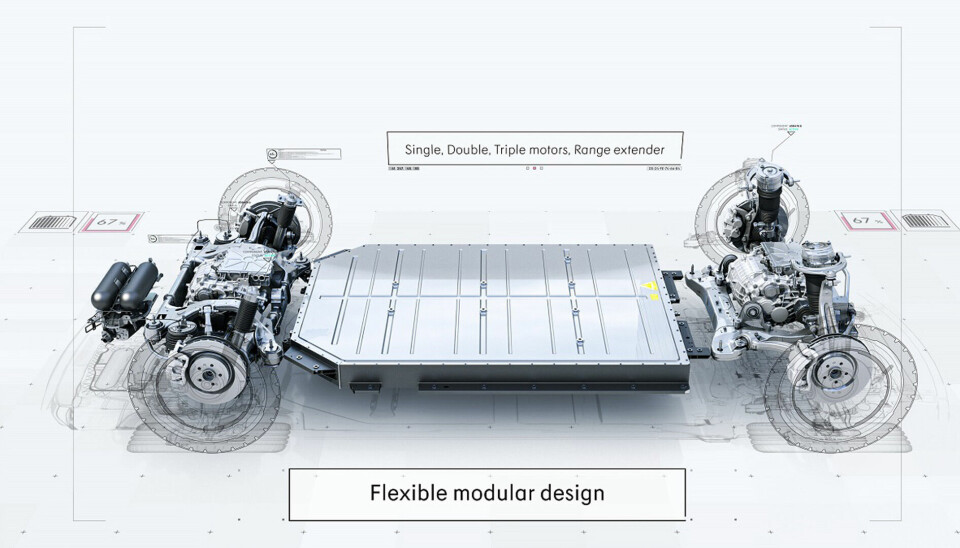
The group's track record in platform development offers some grounds for confidence. Beyond the CMA's considerable volume success, Geely's engineering teams have co-developed the Sustainable Experience Architecture (SEA) family, including the SEA-S platform, which incorporates a 900-volt high-voltage system.
The 900V architecture is significant because it enables substantially faster charging rates and supports higher-performance powertrains in ways that 400V systems cannot match without considerably greater thermal management complexity. The co-development of this platform across geographies is itself evidence that the model Geely Tech Europe is now formalising has already been tested, and has performed.
Geely’s 900V SEA-S Platform showcases strength of global co-development strategy
Software, silicon, and the intelligent vehicle
Of Geely Tech Europe's three stated strategic pillars, the one that most directly reflects the industry's broad structural shift is the mandate for AI-Powered Digital Experiences. The software-defined vehicle has become the organising concept of automotive strategy in a way that would have seemed implausible to most of the industry's senior figures a decade ago. It is now accepted, at least in principle, that the hardware of a vehicle is increasingly a commodity and that differentiated value lies in the intelligence layered above it.
Geely Tech Europe's mandate in this area spans agentic AI, advanced intelligent driving systems (ADAS), smart cockpits, and the data privacy and cybersecurity standards that govern how these technologies can be deployed within European regulatory environments. This last element deserves particular attention.
Europe's data governance framework, anchored by the General Data Protection Regulation and a thickening layer of sector-specific requirements, represents one of the most demanding environments for connected and autonomous vehicle technology in the world. A Chinese OEM that can demonstrate genuine technical competence in this area gains a durable advantage, not just in Europe but in any market where regulators are moving towards comparable standards.

The intelligence required to navigate these requirements is not easily acquired at a distance. It demands engineers who understand both the technology and the regulatory culture from which it emerges, and who can translate that understanding into architecture decisions made months before a vehicle reaches a showroom. This is, in practical terms, one of the strongest structural arguments for the European centre's existence that Geely could have constructed.
Talent and the ecosystem play
Technology organisations of the kind Geely is building do not succeed on the strength of their organisational charts alone. They succeed or fail on the quality of the people they can attract and retain, and on the density of the innovation networks they can access. Geely Tech Europe has signalled that it understands this clearly, with plans to expand its innovation ecosystem through partnerships with universities, technology startups, and innovation hubs across the region.
Gothenburg is a natural home for this kind of endeavour. The city's automotive heritage, anchored for decades by Volvo and its extensive supplier ecosystem, has produced a concentration of engineering talent that is unusual outside of Germany's traditional automotive heartlands. Geely's acquisition of Volvo Cars in 2010 gave the group a foothold in that ecosystem, and the subsequent development of CEVT leveraged those relationships over years of patient accumulation. Geely Tech Europe inherits that social capital.
Frankfurt brings a different dimension. As a financial and logistics hub with strong connections to Germany's formidable automotive supply chain, it offers access to a distinct set of partnerships and a talent pool with deep roots in premium vehicle engineering. LTIC GmbH's origins in the Lotus brand, itself a Geely-owned property with a well-established emphasis on driving dynamics and precision engineering, add a technical heritage that is worth preserving and deploying in the service of the group's wider ambitions.
What the market will decide
Structural reorganisations are, ultimately, promises. The true test of Geely Technology Europe will be the vehicles it produces and the speed at which those vehicles reach international consumers who have no particular reason to be patient. Chinese OEMs have earned a credible reputation for price competitiveness and for moving decisively in electrification, but the premium positioning that Zeekr and Lynk & Co aspire to demands considerably more.
It demands that the engineering decisions made in Gothenburg and Frankfurt translate into products that European customers find genuinely desirable on terms that extend beyond price.
Article Chosen Just For You...
-

Why MG's Czech move is really about its Spanish plant
-

Inside the US tariff turmoil reshaping North American vehicle production
-

VW puts a $18.6bn price tag on cutting excess capacity
-

Valeo puts flexibility at the heart of manufacturing
-

JLR cuts 4,000 jobs to fix an underloaded plant network
-

Hyundai announces 100 new models by 2030
-

JLR turns to Stellantis to build tariff-proof Defenders
-

Stellantis STLA One platform launches in US with Belvidere-built Jeep Cherokee
-

Ford brings Lincoln production home from China by 2030
-

How the EU's Industry Accelerator Act could reshape EV manufacturing in Europe
The group's existing platforms offer a foundation that is more solid than critics of Chinese automotive ambition typically acknowledge. Four million vehicles built on a single architecture is not a footnote. A co-developed 900V platform is not a marketing claim. These are engineering achievements of real substance, and they suggest that the capabilities being reorganised under the Geely Tech Europe banner have been earned rather than assembled for appearances.
What remains to be proven is whether the organisational model can deliver on its most demanding promise, which is the sustained compression of the China-to-overseas launch window to under six months. That ambition requires not just engineering alignment but manufacturing agility, supply chain coordination, and regulatory preparedness across multiple jurisdictions simultaneously. It is, in short, a systems challenge as much as a technical one.
Geely has given itself an unusually honest statement of ambition. The next few vehicle generations will reveal whether the engineering, the organisation, and the market align as intended. Given the group's track record, it would be imprudent to assume they will not.