Key model
How Ingolstadt and Györ work together in building the Q3


Until now, the Q3 was built only in Györ. Now the compact SUV is also rolling off the production line at the Bavarian main plant. Audi is hoping for advantages from the integrated production network in various areas.
Audi needs new impetus. According to its own statements, the manufacturer has brought more than 20 new models onto the market in the years 2024 and 2025 and speaks of the youngest portfolio in the competition. But sales development shows how great the pressure remains. The Audi brand delivered 1.62 million vehicles worldwide in 2025. In the previous year it had still been 1.67 million, and in 2023 even just under 1.9 million. The model offensive has therefore so far had only a gradual effect. This makes the new Q3 all the more important, as it is intended to bring volume in the compact segment and at the same time make better use of the production network.
It is in this environment that the start of integrated production between Győr and Ingolstadt takes place. On 8 June, the first Audi Q3 rolled off the production line at the main plant in Ingolstadt. For Audi, this is more than an additional production start-up. The Q3 stands for the attempt to manage demand, capacities and site roles more flexibly in the European production network. Precisely because the manufacturer has had to defend market shares and volume in recent years, the model is of particular importance.
The Q3 alliance production is an exemplary technical, logistical and organisational collaboration between Győr and Ingolstadt - thanks to the intensive preparation, we can now respond flexibly to demand for the new model
Q3 succeeds the Q2 in Ingolstadt
The Q3 is being produced in Ingolstadt on assembly line 3. Derivatives of the model family around the Audi A3 are already built there, and previously the Audi Q2 was also produced there. With the change from the Q2 to the Q3, the line remains anchored in the compact combustion-engine segment. At the same time, it becomes part of a more complex production model in which Győr and Ingolstadt interlock more closely than in previous collaborations.
The bodies of the Q3 are initially produced at Audi's Hungarian plant in Győr. From there they are transported by rail to Ingolstadt, where they are fed into the further production process, painted and assembled. Audi is thus expanding the role of the main plant: Ingolstadt is not taking on the complete production of the model, but is supplementing the capacities of the Hungarian site in painting and assembly. For the ramp-up of the Q3, this creates a two-site model which, it is hoped, will give Audi greater flexibility.
Plant manager Siegfried Schmidtner places the start-up in a broader context. “The Audi Q3 stands as an example of the future viability and flexibility of the Ingolstadt site,” says Schmidtner. The start of production of the new model at the headquarters is “the result of months of preparation, close teamwork and a lived production alliance between Győr and Ingolstadt”. During the changeover from the Audi Q2 to the Q3, the team in Ingolstadt benefited from its wealth of experience. At the same time, with the preparations for integrated production, Audi showed how professionally the workforce works together across sites.
At Audi Hungary, too, the new production alliance is understood as a strategically relevant cooperation. “The Q3 alliance production is an exemplary technical, logistical and organisational collaboration between Győr and Ingolstadt - thanks to the intensive preparation, we can now respond flexibly to demand for the new model,” says Michael Breme, Chairman of the Board of Management of Audi Hungary.
30 wagons travel back and forth every day
The decisive lever here lies in logistics. Within less than a year, the supply chain teams in Ingolstadt and Győr have established the necessary processes. With the transport of the Q3 bodies from Győr, the transport volume on the route increases by around 50 per cent, according to the OEM. Every day, a full train with 30 wagons is travelling between the two sites. The rail transport is organised as a cycle. The bodies travel to Ingolstadt, empty containers go directly back to Győr. This is intended to create a stable and efficient process that secures assembly supply and at the same time reduces CO₂ emissions compared with alternative transport routes. Audi thus avoids a purely capacity-driven narrative and also presents the alliance production as a logistics project.
Our DB Cargo trains extend the production lines between the Audi plants in Hungary and Upper Bavaria
Stephan Sulser, Managing Director DB Cargo Logistics / Automotive, describes the trains between Hungary and Upper Bavaria as part of the production system. “Our DB Cargo trains extend the production lines between the Audi plants in Hungary and Upper Bavaria,” says Sulser. DB Cargo is pleased “to support the integrated production of our top customer Audi with the strength of the European DB Cargo network”. The sentence makes clear what it is fundamentally about: The factory no longer ends at the factory gate. It is organised across sites via rail, container cycles and production planning.
Main plant also continues to build the PPE models
For Ingolstadt, the Q3 launch is at the same time part of a transition phase. The plant continues to build two compact combustion models with the Audi A3 and the Audi Q3. At the same time, Audi is driving forward the electrification of the main plant. After the delayed start of production of the Audi Q6 e-tron in the year 2023 and of the Audi A6 e-tron in the year 2024, a further fully electric model series is due to start in Ingolstadt in the autumn. “The Audi A2 e-tron is the next milestone for Ingolstadt on the way into the electric age. I am proud that this car is being produced at our home site,” says plant manager Schmidtner.
It is precisely this parallelism that makes the situation at the site clear. In the short term, Ingolstadt must secure volume with combustion-engine models and at the same time drive forward the transformation to electric mobility. The Q3 is therefore not just another model on an existing line. It is also a building block for stabilising capacity utilisation, employment and production expertise during the ongoing transformation.
Historical connections between the two plants
Both sites were already working closely together on the Audi TT. From 1998, the TT Coupé and from 1999 the TT Roadster were produced in integrated production. At that time, the painted bodies came from Ingolstadt, while assembly took place in Győr. After the opening of the new vehicle plant in Győr in 2013, the entire production process of the TT was relocated to Hungary.
The sites also gained experience in working together on the A3 Saloon. Series production started in 2013 initially entirely in Győr. In phases of capacity management there were additional collaborations with Ingolstadt, however on the basis of a separate production logic.
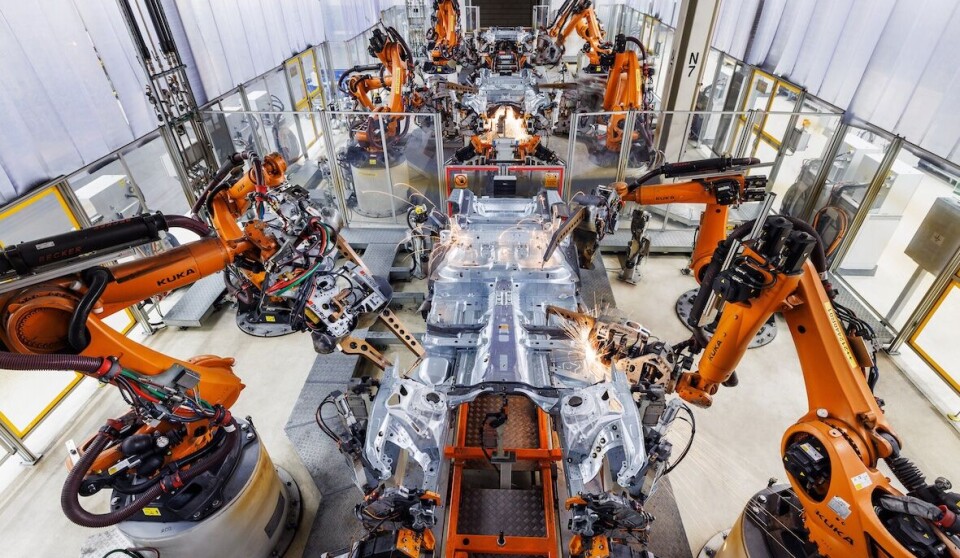
For the Q3, the operating model is more complex. Whereas for the A3 a separate production line served the requirements from Ingolstadt, now the same production line supplies two paint shops and two assembly lines. This requires more precise planning because the requirements of both sites have to be taken into account in a shared system. Audi therefore speaks of a new level of cross-site collaboration.
From a bird's-eye view, this production ramp-up thus shows in exemplary fashion how strongly the control of modern vehicle plants is changing. Capacity does not arise solely through additional lines or new halls. It arises through the ability to synchronise sites, transports, empty-container flows, paint shops and assembly lines in a common system. For Audi, the Q3 is an important testing ground in this regard. The model is intended to help meet demand in the compact SUV segment, while the group presses ahead with its electrification and, after years of declining deliveries, wants to bring more momentum back into the market.