
BASF takes a mass-balance approach to Toyota’s truck bed
Toyota’s Tacoma short-bed pickup is now fitted with a sustainable thermoplastic truck bed made from an innovative material from BASF
The 2026 Toyota Tacoma short-bed model has a paint-free thermoplastic truck bed made from a durable glass fibre-reinforced polyamide material that is being supplied by BASF and manufactured by tier one supplier Vuteq. It is resistant to impact and adverse weather conditions. In November this year it won the 2026 Society of Plastics Engineers (SPE) Automotive Innovation Grand Award for the most innovative product in all competition categories, as well as the body exterior category.

The truck bed is made at Vuteq’s facility in Apaseo el Grande, in Guanajuato, Mexico, near Toyota Motor Manufacturing Guanajuato, which makes the Tacoma and is using a specially designed 12,000-ton injection moulding machine from Engel (see box). Series production and deliveries began in the second half of 2026.
The moulded bed structure has three pre-moulded structural crossmembers over-moulded into it. According to BASF the three pre-moulded arched structural crossmembers are loaded into the mould before the main shot. The bed material over-moulds these supports, creating an integrated assembly without mechanical fasteners, which simplifies production. This reduces secondary assembly while preserving the structural architecture required by the application.
It was conceived on three connected innovations: large-part manufacturing scale, material innovation and sustainability. The result is reduced final part cost and enhanced manufacturing efficiency.
Material performance

According to Dr Matt Parkinson, head of technical development engineering and PPA business development for BASF Performance Materials in North America, the thermoplastic truck bed was developed primarily for benefits other than weight reduction. It removes the need for paint (among other sustainable attributes), facilitates part integration, reduces secondary operations and lowers final part cost.
Toyota says that the Tacoma truck bed project is part of Toyota North America’s efforts[PP1] to reduce carbon emissions and reuse materials in the development of its products.
“These efforts build on Toyota’s pillar of continuous improvement across all areas – manufacturing, product design, and supplier relationships,” says the carmaker. “In North America, this translates into our circular economy goals for key automotive parts, which is included in our efforts to reduce carbon across our operations and products by 2050.”
The truck bed is made from Ultramid, a 50% glass-fibre-reinforced, impact-modified PA6 material – a tough, semi-crystalline thermoplastic engineering plastic. The material has been developed as an alternative to painted, long-glass-fibre sheet moulding compound (SMC), according to BASF. It is used for moulding very large, complex parts while achieving a surface quality that eliminates the need for paint.
The material also provides stiffness, point-load impact resistance, long-term structural durability and UV-weathering performance.

Mass-balance material
“BASF incorporates recycled raw materials into its chemical production system and attributes an equivalent share to the Ultramid used for the truck bed through its certified mass-balance approach,” says Parkinson.
BASF is then able to allocate the credited raw materials to specific products. In this way it can increase the proportion of sustainable raw materials used in production. Like the power grid, which can draw from both conventional power plants and renewable energy sources, customers can decide if they want to support renewable materials. The mass-balance approach enables the use of alternative raw materials in an existing complex production network. Each site that produces mass-balance products has each product independently verified and certified. Toyota and Vuteq support the application, qualification and production of material for its use in the Tacoma truck bed project.
Recycling the bed
As previously announced in the SPE press release, Toyota and BASF have signed a Memorandum of Understanding (MOU) to explore pathways for recovering, processing and reusing thermoplastic truck bed material at vehicle end of life. Future implementation remains subject to technical validation, collection infrastructure and commercial feasibility.
Furthermore, Vuteq is investigating recovery and reuse of qualifying manufacturing scrap for potential future production.

“Manufacturing scrap would first have to be segregated, shredded or reground, and converted into a consistent feedstock,” Parkinson says. “It would then undergo sampling and material validation before an approved percentage could be blended with virgin material for potential use in future production.”
Future implementation remains subject to technical validation, collection infrastructure and commercial feasibility. The potential material reuse and streamlined manufacturing support Toyota's 2050 sustainability goals, including increased recycled material utilisation and CO2 reduction.

Computer-aided engineering
BASF says the scale and complexity of the application pushed the boundaries of conventional analysis, requiring accurate prediction of mould filling, fibre orientation, dimensional stability and structural performance. Parkinson explains that BASF’s Ultrasim computer-aided engineering capabilities supported the development throughout the design process. That included mould-filling simulation to optimise processing and predict fibre orientation. It also included structural analysis using BASF material models to predict performance under critical-load cases. Finally, it included design optimization and validation to address dimensional stability, warpage and structural requirements before physical testing. These simulations were correlated with physical testing to help validate the final design, according to Parkinson.
The innovative thermoplastic manufacturing platform has established a new benchmark for large-scale structural thermoplastic applications. Parkinson says the material provides a unique combination of structural performance, impact resistance, processing capability and exterior surface quality at a scale not traditionally associated with injection-moulded thermoplastics.
“These capabilities create opportunities for other large structural and exterior applications,” adds Parkinson.
Potential recycling programmes could also support material recovery, helping companies make their vehicles more sustainable while maintaining structural performance and at the same time cut manufacturing costs.

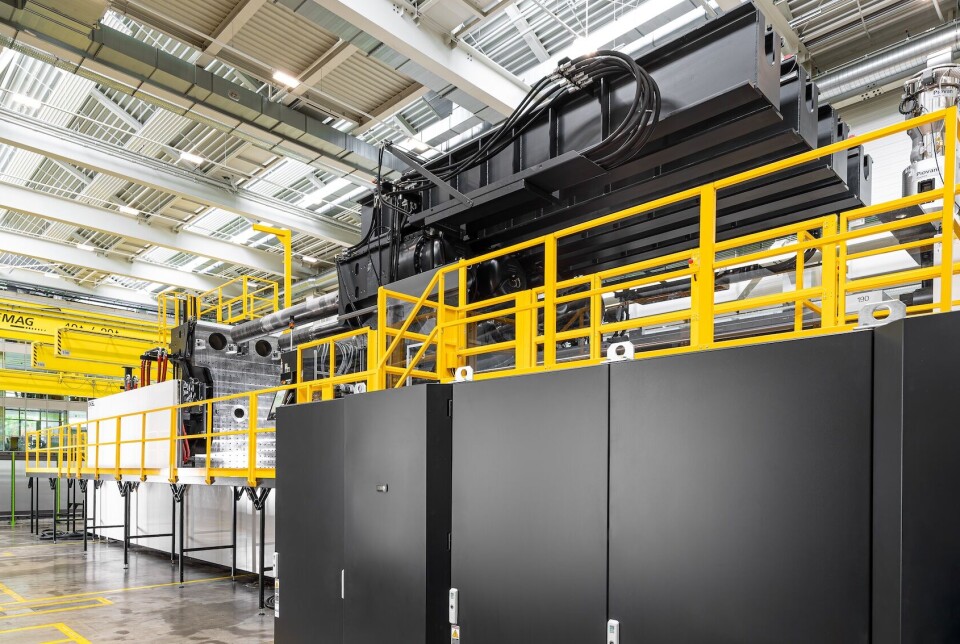
Engel 12000 injection moulding machine
Engel’s 12000 US two-platen injection moulding machine is one the largest industrial production systems in injection moulding worldwide and was specifically developed for parts with projected areas of more than 2.5 sq.m so that manufacturers can produce large-format structures in a single production step. This reduces material usage, simplifies production logistics and saves time and costs, according to the company.
The machine installed at Vuteq’s facility in Guanajuato has 110,000 kN/12,000 US tons of clamping force specifically for the truck bed.
The machine reduces parts costs for large-area components and reduces assembly complexity. According to Engel it enables manufacturers to come up with new designs and replace traditional materials such as metal with plastics.
To enable large shot weights for large-area components, the system is equipped with two injection units operating in parallel. With screw diameters of up to 210 mm, they enable a shot volume of up to 65,000 sq.cm and homogeneous filling of large projected areas.