
New hall, old standards
How Porsche builds the body of the new electric Cayenne
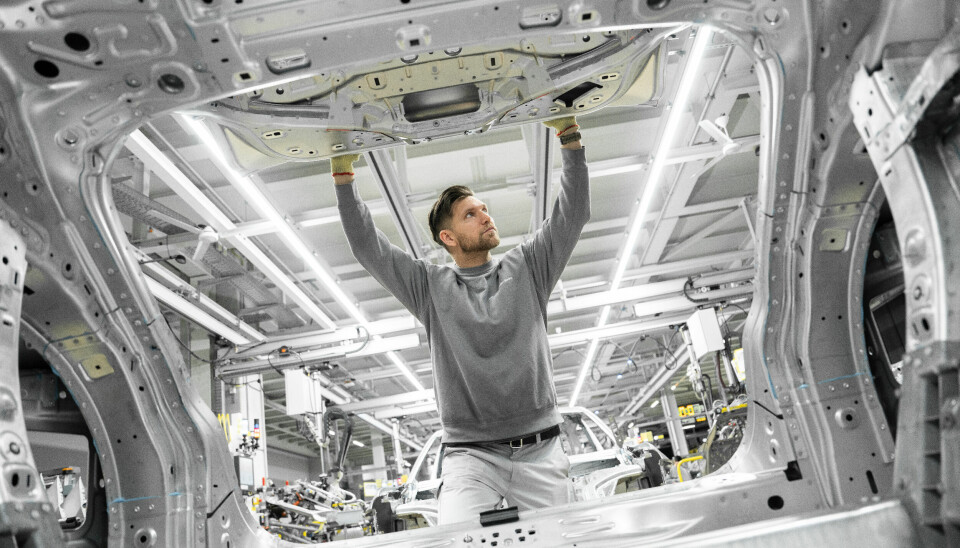
The electric Porsche Cayenne is being produced at the Volkswagen plant in Bratislava. The body construction is highly automated, the material mix is complex, and the platform is newly conceived. A tour through a production in its ramp-up phase.
The floor is light grey, the walkways are marked in white, and at intersections, there are semi-circular convex mirrors. In between, robotic arms move in steady rhythms. In the body shop of the Volkswagen plant in Bratislava, several hundred robots are working on the most powerful Porsche of all time. More than 90 per cent of the processes are automated. Nevertheless, the hall does not feel like a secluded machine world, but rather like a precisely organised traffic system: Zebra crossings structure the paths, glass walls separate people and machinery. Safety and rhythm determine the pace. The site is in the ramp-up phase of a vehicle that is more than just a model change for Porsche. With the E-Cayenne, a new production logic begins.
Jan Drinka, head of the Porsche body shop, knows the contrast. He has been working at the plant since 1992. Back then, Drinka says, he used to assemble bodies with hand welding equipment. Today, none of that remains. Robots from Fanuc and Kuka take over welding, joining, and inspection processes. Cameras are directly integrated into the systems. They measure geometries, check tolerances, and evaluate measurement points in the ongoing process.
The goal is a closed, quality chain. Errors should be detected where they occur. "Quality is quality," says Drinka. Components that exceed defined limits are reworked or scrapped if in doubt. Especially during the ramp-up, this consequence is part of the strategy.
Production of the electric Cayenne

- Production location: Bratislava, Slovakia
- Production principle: Combustion engine, hybrid and BEV on a common line
- Platform hall: New building for E4 architecture, skateboard-like chassis
- Body construction: Over 90% automation level, camera-based in-process inspection
- Battery modules: Manufacturing in the Smart Battery Shop Horná Streda
- Module structure: 6 battery modules per vehicle, modular construction
- Quality & data: RFID tracking per vehicle, central real-time monitoring of production data
A new platform hall as a starting point
For the new Cayenne, Porsche has specifically expanded the multi-brand site in the Devínska Nová Ves district. The heart of the conversion measures is the new platform hall. Here, the skateboard-like chassis is created, which is then supplemented with side walls, roof, doors, front bonnet, and tailgate in the following stations. The add-on parts come from the press shop, which operates with a nearly fully automated press line. The maximum pressing force of the main press is 91,000 kN. The body shop has thus not only been expanded but also structurally redesigned. The platform hall is the point where the architecture, material mix, and process logic of the electric vehicle converge.
The difference from the previous generation is visible in the underbody. The classic tunnel is missing in the middle. Instead, the structure is designed for the integration of the high-voltage battery, which is later inserted into the body from below. Dark components mark high-strength steel components in the central area. They take on structural tasks where the battery becomes part of the overall system. The rest of the body is predominantly made of aluminium. The steel content is around 18 per cent. The Cayenne Electric is consistently designed as a mixed construction.

Mixed construction forces new joining technology
The material mix places high demands on body construction. Aluminium and high-strength steel must be securely joined without compromising their respective properties. Porsche relies on flow-drill screws, punch rivets, as well as friction and drive element welding for this purpose. These mechanical processes are complemented by a high proportion of adhesive technology. Around 300 metres of adhesive are used per vehicle. Structural adhesives, acoustic adhesives, and support adhesives take on functions that were previously solved purely mechanically. The increasing proportion of adhesives is less an expression of a trend than a constructive necessity to simultaneously manage stiffness, acoustics, and weight.
Cameras instead of spot checks
A central element of body construction is camera-based quality control. Every body is inspected. Robots measure defined points, compare target and actual values, and evaluate the results in real-time. Deviations are documented. In downstream stations, employees decide based on the data whether rework is possible within the cycle time or if the vehicle needs to be removed. Repair boxes are provided for this purpose. The logic is strict. Quality takes precedence over throughput.
Technically striking is a shielded system, referred to in the factory as the "green pigskin." A dark green-black striped protective cover shields processes during the mixed welding of aluminium and steel. It reduces light influences and protects camera-based systems from interference. Such details seem inconspicuous but are crucial for stable measurements. As sensor technology increases, so does the sensitivity of production to environmental influences.

Start-up with a clear target size
The Cayenne Electric is still in its ramp-up phase. Currently, around 50 vehicles are produced per week. The target size is significantly higher. In the long term, 143 units per shift are planned. The body shop is currently operating in one shift. After the ramp-up is completed, three shifts are planned. Currently, around 40 employees per shift work on the underbody and add-on parts in the hall. The number illustrates the degree of automation. At the same time, the need for system expertise, maintenance, and process monitoring is growing.
Within the hall, a dedicated technology cell has been set up for this purpose. It is separated by glass walls and serves for training and maintenance. Employees prepare interventions here and stabilise processes. The actual work in the body shop is less about manual joining and more about monitoring, analysing, and intervening. The hall is about twelve metres high. Robot cells are fully enclosed.
Logistics between target image and reality
Automation does not end at the facility. Driverless transport systems move material through the hall. They follow marked routes, pull trailers, and supply the stations automatically. Some of the systems are from Grenzebach. Drinka emphasises that the goal is to rely entirely on AGVs from the moment the logistics area is left. Human forklift drivers remain in use where material is taken from high-bay warehouses. From a defined boundary, transport should be fully automated.
The current operation shows how challenging this transition is. In certain areas, traditional industrial trucks are still used. Front flaps are manually unloaded, positioned, and then taken over by the robot. The material flow is already largely automated, but not yet fully decoupled from humans. Variety of variants, container management, and ramp-up dynamics set limits.
Finish as a deliberate contrast
While the body shop is highly automated, a different picture emerges in the finish. In the assembly line, many employees work manually. They check gap dimensions, align add-on parts, and correct deviations. Hammering noises made by humans will still be part of the overall picture of this ultra-modern body shop hall in 2026. The sequence is clearly defined. Adjustments begin at the rear, move forward, affect the fenders, and finally the front flap. Automation would be technically possible, but it is organisationally complex. The multitude of parts, containers, and variants makes stable robotic solutions difficult.

Drinka describes this area as deliberately designed to be flexible. Automation is only to be further expanded here once all variants are stable in series production. Otherwise, systems would have to be constantly adjusted. The high manual proportion is not a step backwards but part of a start-up strategy.
Body construction as part of a flexible overall line
From 2026, the Cayenne Electric will be manufactured in Bratislava on the same line as the combustion and hybrid variants. This multi-drive strategy increases complexity but creates flexibility. The body must be able to accommodate all variants. Accordingly, the requirements for structure, joining technology, and quality assurance are high. Body construction thus becomes the key to cushioning volatility on the market side.
The acceptance control of the body marks the transition to the paint shop. Only when joints, geometry, and surfaces are within the defined tolerances is the body passed on. The body construction of the Cayenne Electric in Bratislava is not a showcase project. It is a workshop in transition. New platform, changed material mix, new joining technologies. High automation where processes are stably controlled. Deliberate manual work where variant diversity and quality assurance require it.
The electric Cayenne is thus, less a single vehicle project than a test-case for Porsche-typical series stability in the electric age. And Jan Drinka's new body construction hall plays a part in determining whether the claim to depict performance, precision, and quality reproducibly, regardless of the drive, can be fulfilled in industrial everyday life.