Brownfield transformation
“Our production network must be able to breathe”


In the interview, project manager Patrick Walz explains how digital twins, flexible production lines, AI and local battery assembly are changing Kecskemét.
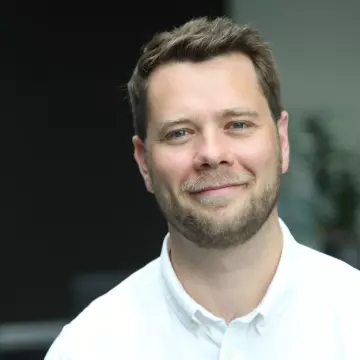
Patrick Walz is a graduate engineer and has more than 16 years of experience in the international automotive industry. He has been working for Mercedes-Benz since 2013 and has been responsible there for various major international projects in production planning, industrialisation and site development. Among other things, he led the planning of the engine plant in Jawor, Poland, and was involved in the development of the Mercedes-Benz Drive Systems Campus in Untertürkheim.
Since 2022, Walz has been responsible as Senior Project Manager for the expansion of the plant in Kecskemét, Hungary. With the electric C-Class, the site is producing a model from the core segment for the first time. In future, the electric GLC and, exclusively, a small, more compact version of the G-Class are also to be built there. In the interview, Walz talks about conversions during ongoing production, digital twins, flexible production axes, qualification and the local manufacture of batteries.
Mr Walz, what are the most important reasons for the investment in the expansion of the Kecskemét plant?
We already have a strong plant here. With the start of production of the new electric C-Class, we are now expanding the product portfolio in Kecskemét to include the so-called core segment.
Which larger conversion or modernisation projects have you most recently implemented within the production network, or are you currently preparing?
If we are talking about Kecskemét, we can first look at the northern part of the plant. There, we integrated the GLB into the already existing assembly, body shop and paint shop. And in Bremen, for example, the new electric GLC was fully integrated into the existing assembly hall. Another example is the new paint shop under construction in Sindelfingen. This project is being created in line with the new paint shop in Kecskemét. Just like here at the site, the aim is to save water and energy and to dispense with fossil fuels.
How important is flexibility in today’s automotive production?
It is extremely important. We have to be able to respond at short notice to demand or to the requirements of our customers. In the company, we speak of so-called flexible production axes. Our production network has to be able, in a sense, to breathe. This allows volumes to be shifted as needed and changes to be responded to more quickly.

Which production area is particularly challenging when converting an existing plant: body shop, paint shop or assembly?
Each area has its specific requirements. However, the body shop is particularly complex. There we have to take the architecture of the vehicle into precise account. Is it an electric vehicle, a vehicle with a modern internal combustion engine or a facility that is intended to depict both types of drive? Added to this is the age of the existing equipment. After all, our body shops are not designed only for one model life cycle. The particular challenge consists in carrying out this work without interrupting ongoing production for longer.
How can such conversions be planned during ongoing operations without causing major production downtime?
The C-Class from Kecskemét


A central success factor is our digital planning. Today, a very large proportion of the equipment and processes is initially planned virtually. Here in Kecskemét, our Digital Factory Twin was used for digital planning. We used digital twin technology for the first time at the Mercedes-Benz Rastatt plant: production of the CLA there was preceded by the extensive conversion of an existing assembly hall in record time.
This conversion was depicted virtually in advance with the help of a digital twin. We plan, simulate and test the processes before the first steel column is erected in the hall. This allows us to identify possible collisions or design errors in advance. This extends to supposedly small details such as the question of whether a light fitting could collide with new equipment. The factory is depicted in a digital twin. This allows us to enter assembly halls, body shops and paint shops virtually, plan in new equipment and check at which point it can be installed. This is followed by virtual commissioning.
In doing so, we test, among other things, the communication between conveyor technology, tools, platforms and the other systems in the hall. In this way, we identify at an early stage whether there are conflicts between programs or equipment. Time planning is also crucial. In the body shop, for example, we can carry out certain conversions over a weekend. Production ends on Friday, then together with the suppliers we convert individual areas. On Monday, regular production can start up again. This requires very close coordination between production planning, maintenance, logistics and our partners.
How do you prepare production employees, maintenance and managers for new systems, processes and safety requirements?
We involve all partners and suppliers in the process at an early stage. Here too, the digital twin plays an important role, because all those involved can already view the future systems and processes before the real implementation. Those involved in the project can see whether a planned sequence makes sense in practice. Manual processes and the provision of material can also be simulated. Even individual movement sequences of the employees can be digitally simulated and analysed.
In this phase, the experience of our production employees is also incorporated. Our maintenance team is also involved in discussions with our suppliers at an early stage. From past experience, our colleagues know best which sources of error can occur with certain systems. This knowledge helps us to design the new technology better right from the start. During a ramp-up, the suppliers are initially on site and support us in operating the systems. Our own employees then gradually take over.
The basis for this is targeted qualification - here in Kecskemét, for example, we have our own Mercedes-Benz Academy. In addition, there are training islands where employees can practise their later work steps. The processes are first trained digitally and then on the real vehicle.
How important are qualification and further training in view of the shortage of skilled workers?
They are indispensable, because only in this way can we consistently maintain our quality standards. Anyone who buys a Mercedes expects the highest quality. We are committed to this promise in every production step. Especially during a production ramp-up, everyone involved must know exactly what to do. For this, we rely on training concepts that are used worldwide within Mercedes-Benz production. In this way, we specifically bring our employees to the qualification level required for their tasks.
The AI-supported Octopus system is used at the plant during the final inspection. How much does such a technology change quality assurance?
The cobot is our “MO360 AI Vision System”. The installation is a genuine innovation and makes a significant contribution to reliably ensuring Mercedes-Benz quality. It is used at the end of production for the final inspection. The AI learns with every vehicle and with every detected identified deviation. As a result, the system continuously improves its ability to detect errors. At the same time, direct feedback to production is created. We can see which processes may need to be optimised or improved. The system is fully integrated into the production process. The vehicle drives into the station, the arms of the cobot move with their “camera heads” into the vehicle interior, create images and immediately deliver the inspection result.
What significance does sustainability still have in the face of cost pressure and volatile markets?
Sustainability is a key cornerstone of the corporate strategy. Let me take Kecskemét as a current example: here, for example, we are investing in a 240,000 m² photovoltaic park and in photovoltaic systems on the roofs of the halls. The solar power generated, at around 42.3 MWp, can cover around 25 per cent of the annual energy requirement. This is complemented by extensive wildflower areas that strengthen biodiversity at the site. This shows that sustainability was already an integral part of our planning in the planning phase for the plant expansion. This is also about greater independence and a more economical use of resources. In the paint shop, for example, reducing energy and resource consumption plays an important role.
Are these goals actually reviewed by the Board of Management?
As I said, we have a clear sustainability strategy. You can find details on key figures, progress and measures in our sustainability reports published annually.
Body parts and batteries are produced directly at the site. What significance does this have for the local-for-local strategy?
Battery assembly was already an integral part of our planning in an early project phase. It is one of the central elements of the local-for-local strategy and strengthens value creation directly at the site. Integrated into local logistics, including through electric lorries, it contributes directly to our sustainability goals. At the same time, battery assembly makes us more independent. We can manufacture the required battery systems directly here at the site and are not dependent on sourcing them from other parts of the production network.
This also shortens the feedback loops here. The press shop and body shop are also directly connected here at the site through their value creation. If a component arrives in the body shop that does not meet the requirements, the colleagues from the press shop can react immediately. These short distances are also crucial for quality.
Which approaches have particularly strongly improved the logistics processes in Kecskemét?
Right next to the plant there is an industrial park that is closely connected to production. And particularly in the new assembly area in the southern plant, the “One Roof” concept has been implemented consistently with an integrated I-Park. This means, for example, that seats can be delivered directly from there to the assembly line. A central element of efficient logistics here at the site is the reduction of complexity. Short, clearly structured routes within the halls ensure a fast and reliable supply of the production stations.

To what extent are the logistics processes automated?
I cannot state a specific percentage for competition law reasons. However, we have examined every single logistics process and assessed which supply concept is best suited. This may involve driverless transport systems, so-called Automated Guided Vehicles, or traditional tugger trains. The respective systems are used where they bring the greatest benefit. Each station is, as mentioned at the beginning, virtually simulated, analysed and evaluated on the basis of defined key figures. On this basis, we decide which concept is the best solution for the respective process.
In which production areas has automation brought the greatest changes? And where is there still further potential?
We are experiencing changes through automation in all production areas - to varying degrees depending on the process. Bodyshop already has a very high degree of automation with around 1,200 robots. The new paint shop is also highly automated. The AI vision system in vehicle assembly already mentioned is another good example. In the past, employees visually inspected the vehicle interior. However, an AI-supported camera can detect certain deviations that are difficult for the human eye to see.
In addition to the electric C-Class and the electric GLC, a small, more compact version of the G-Class is also to be manufactured exclusively in Kecskemét. What can you already tell us about this model and its production?
At the current stage of planning, we are not yet providing any specific details about this model and its production. Good stories always need a bit of a run-up - and we are already looking forward to telling you about it as soon as the time comes.