Developing and deploying smarter automation and digital systems

As the hype around smart factories gives way to hard commercial reality, a new AMS livestream will bring together senior voices from Audi, Solidigm and the Manufacturing Technology Centre to examine what AI, digital twins and flexible automation are genuinely delivering – and where the limits still lie
The automotive industry has spent billions on digital transformation. Pilot programmes have been launched, vision systems installed, AI roadmaps drawn up and digital twins commissioned. But the question being asked in OEM boardrooms and on plant floors alike is how much of it is really working?
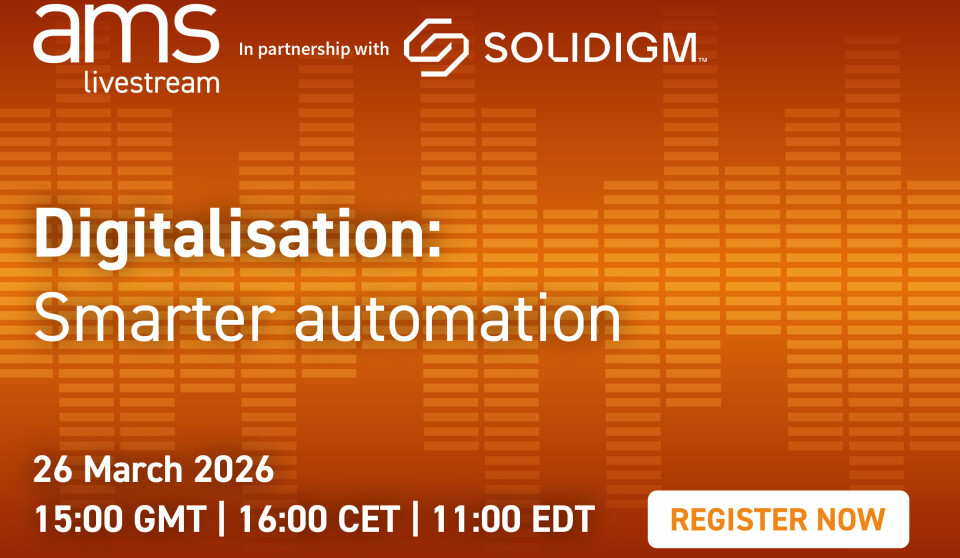
That question sits at the heart of a forthcoming AMS livestream, Digitalisation: Smarter Automation, which will examine how leading manufacturers and technology providers are deploying automation that genuinely delivers – systems that enhance human capability and are scalable.
The automotive industry is at a pivotal moment. Vehicle mix is rising, EV and hybrid production is scaling rapidly, and cost pressures are intensifying across the supply chain. Legacy automation strategies designed for high-volume internal combustion engine programmes do not always translate cleanly to the demands of mixed-model EV-ready lines. As AMS analysis has shown, flexibility now matters as much as throughput – and the questions around where to automate, how much to spend and when to rely on human skill have never been more important.
From proof of concept to measurable value
Digitalisation in automotive manufacturing has moved beyond the era of bold ambitions and proof-of-concept projects. The new imperative, as the AMS content agenda has consistently reflected in recent months, is translating data, AI and flexible production strategies into a practical, scalable and accountable advantage. Recent AMS coverage has explored how OEMs are navigating this transition; from Opel's recalibration of assembly automation across two plants, to BMW's development of a new centre for physical AI in Munich, where adaptive robotics is being taught to correct its own errors. Volkswagen's Palmela facility in Portugal offers another telling example – a plant where tight margins and complex logistics constraints are shaping a highly practical approach to production flexibility ahead of multi-model EV production in 2027.
Across these cases, a common theme emerges; the most impactful automation investments are not grand technological leaps but carefully targeted combinations of AI-assisted programming, condition monitoring, digital simulation and modular intralogistics. The challenge for manufacturers is being disciplined enough to identify where those combinations return measurable value – and honest enough to acknowledge where they do not.
Join the conversation: The AMS Digitalisation: Smarter Automation livestream is free to attend. Register HERE
Addressing key questions
The session is structured around three of the most pressing questions facing automotive manufacturing leaders right now.
First: How far can vehicle assembly automation realistically go, and where does human-machine collaboration produce better results than full robotics? The assembly line is evolving – modular cells, intelligent sequencing and collaborative tools are reshaping production from the rigid choreography of traditional high-volume manufacturing into something more adaptable – but the pace and limits of that change remain hotly debated.
Second: How does digitalisation support mixed-model, EV-ready production? The so-called linear assembly line has served the industry for over a century, but the combination of rising variant complexity and electrification is forcing manufacturers to rethink factory architecture from the ground up.
Third: How are edge computing, digital twins and AI being applied on the shopfloor in ways that translate into real productivity gains? The livestream will move beyond theoretical use cases to examine practical deployment examples, drawing on the expertise of speakers directly involved in AI strategy and advanced storage infrastructure for industrial AI workloads.
Why this conversation matters now
The timing of this livestream reflects a genuine inflection point for the industry. European OEMs and suppliers are navigating simultaneous pressures: the cost of electrification investment, the complexity of managing mixed ICE, hybrid and EV production on shared platforms, geopolitical disruption affecting supply chains, and intensifying competition from Chinese manufacturers that have built highly automated, digitally integrated factories from scratch.
Against that backdrop, smart automation is not a luxury or a long-term aspiration. It is an operational necessity. But the risk of misallocating capital on technology that does not deliver is equally real. The AMS livestream is designed to help manufacturing leaders with focusing not on what is theoretically possible, but on what is actually working, at scale, in production environments today.
There is a lot going on in the background that will change manufacturing going forward. This session is an opportunity to understand exactly what that means in practice – and how to apply it in your own operations.