
EV Skunkworks
Ford's California lab reshapes EV production


In a Long Beach campus far from Detroit, Ford has assembled a 350-strong team tasked with reinventing its electric vehicle architecture from the ground up - blending startup speed with century-old manufacturing depth.
Ford has a tradition of hiding talented people away and letting them get on with the business of carmaking. In 1907, Henry Ford cordoned off the third floor of the Piquette Plant in Detroit and tasked a small team with designing a vehicle that would change the world. The result was the Model T. Ford is doing something similar again, though this time the sequestered team is 350 people strong, the location is southern California rather than Michigan, and the problem to be solved is not how to put a car within reach of the masses - it is how to make an electric one that actually makes economic sense.
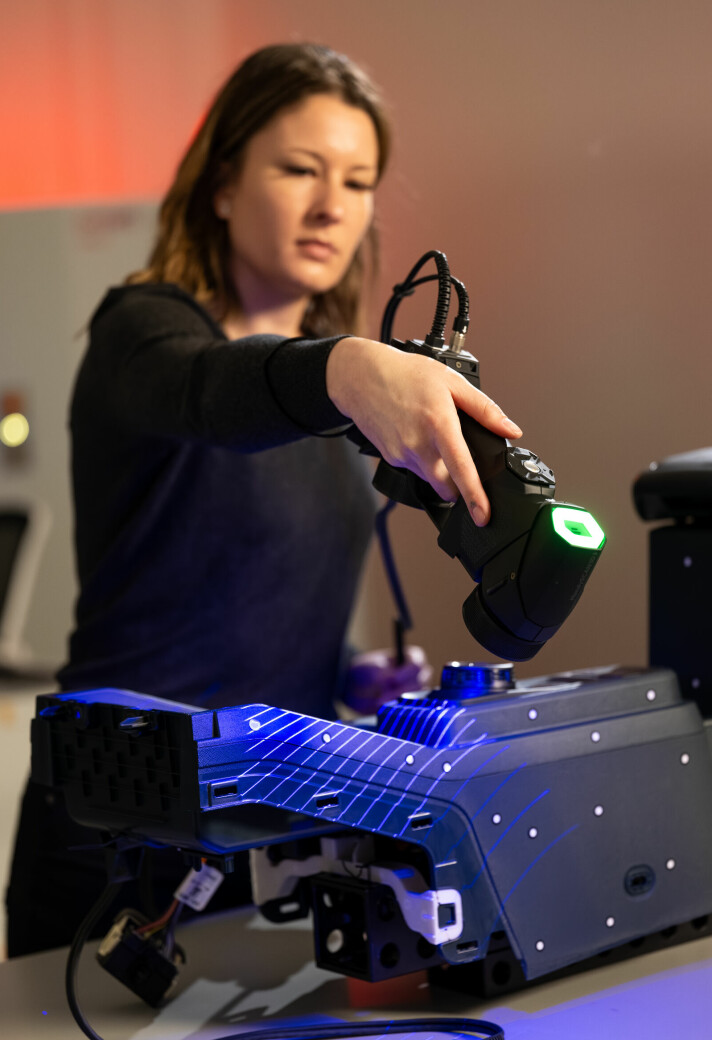
What began three years ago as a genuinely covert skunkworks project has since matured into the Electric Vehicle Development Center (EVDC), a two-building campus in Long Beach occupying a combined footprint of well over 240,000 square feet.
The team within it blends Ford veterans with engineers and designers recruited from automotive startups and consumer electronics, all working on a single objective: Ford's Universal EV Platform, upon which an affordable midsize truck is due to launch next year, with further models to follow.
When Ford's president and chief executive Jim Farley announced the Universal EV Platform at a Louisville, Kentucky event last August, he was unambiguous about its historical weight. "We tore up the moving assembly line concept," he said, "and designed a better one." The Long Beach campus is where that redesign is being executed.
"Innovation, ultimately, is what is going to help Ford win," said Alan Clarke, vice president of Advanced Development Projects. "It is a whole different culture when you mix that all up."
Proximity as a design tool
The EVDC operates on a principle that sounds simple but is rarely achieved in large organisations: put everyone in the same building and let them talk to each other. Designers, engineers, battery scientists, and supply chain experts work within a few hundred feet of one another. Formal meetings give way to corridor conversations, and corridor conversations, it turns out, have measurable financial consequences.
Akshaya Srinivasan, director of range, performance and battery systems modelling, described a recent exchange with colleagues from the powertrain team that began over boba tea and ended with the battery's cell count reduced, saving several hundred dollars per vehicle. "It is about making decisions quickly, always moving forward," she said. "Being together under one roof, it really does help. It allows us more conversations. You end up solving something more quickly."
The Ford EVDC Floorplan in Long Beach, California

Daniel Smith, director of occupant architecture and seating, was among the EVDC's first employees, when the project was still operating under its skunkworks designation from a borrowed office in nearby Irvine. He frames the ethos of the centre not as a matter of process but of motivation. "These are not people that just got a project assigned to them," he said, "but people who are mission-driven on that topic."
The campus also includes a floor-to-ceiling LED wall capable of displaying life-sized vehicle renders and large enough to accommodate multiple physical prototypes being driven inside simultaneously. It serves double duty as a remote collaboration tool, connecting the Long Beach team with roughly 500 colleagues working on the Universal EV Platform at Ford's sites in Dearborn, Palo Alto, and Louisville. "We are not waiting for a more formal forum to make the decision," said Yohann Ory, head of design.


The studio at the centre of everything
At the physical heart of the campus sits a 22,000-square-foot design studio. It houses seven milling towers for scale modelling, a fleet of 3D printers, a trim shop equipped with industrial sewing and cutting machinery, and a 360-degree turntable. A five-axis Fooke 911 gantry machine with a large robotic arm can mill a full-size vehicle model as large as an F-150 in a matter of days, while water-jet cutters handle metal fabrication.
The net effect is that the gap between a digital design and a tangible prototype - which in conventional automotive development typically runs to months - has been compressed to as little as 30 minutes for simple parts and a few days for full-scale models. "We are going to get as much a quality benefit as a quantity and speed benefit," Smith observed. "Our absolute deadline might not change. But we can do three or four more iterations and try more variety, while taking more risks to try crazy ideas in-house."
For interior and seating components, the trim shop cuts that turnaround from a typical three months to as few as two weeks. Scott Anderson, senior manager of seating, describes the capability as allowing teams to move from virtual design to a physical object that "we can all poke and prod and determine what's good, bad, or absolutely fantastic."
Eva Ross, a designer on the team, puts it succinctly: "Everything you touch goes through the design studio's hands to make it real for our customers. We go through the whole process from that early initial sketch to understanding the production implications."
Having everything here, we can go back to the vehicle and see how it works, take parts off, test a cell
Testing as a first resort
Long Beach's testing infrastructure treats prototypes not as finished outputs to be validated but as instruments of learning. The battery laboratory contains a thermal shock chamber for pack-level testing and an ultra-high-precision coulometer that can simulate years of degradation in a matter of weeks. A thermal lab can house an entire vehicle and subject it to environmental extremes. A climatic chassis dynamometer - using 48-inch rollers to replicate wind resistance, speed, humidity, and gradient - gives engineers a controlled environment in which to hunt for efficiency gains before a vehicle turns a wheel on a public road.

"Having everything here, we can go back to the vehicle and see how it works, take parts off, test a cell," Srinivasan said. "And it can all happen in one day." Her team's governing principle is blunt: "Testing early, fail fast. That is one of our commandments. We target zero failures, so we have to understand where they failed. Our goal is to build and design the system that rarely, if ever, fails in our customer's hands."
From California to the factory floor
The Long Beach team's work is not an exercise in isolation. Every innovation developed at the EVDC is designed to transfer directly to Ford's Louisville Assembly Plant, where the midsize truck will be built, and to subsequent vehicles on the Universal EV Platform. With the battery pack accounting for roughly 40% of an EV's total cost, the pressure to drive down component counts and assembly complexity is considerable.
The effort so far has produced meaningful results. The Universal EV Platform contains 20% fewer parts than the architecture it supersedes and 50% fewer cooling hoses and connections. Assembly of the midsize truck is projected to be 15% faster than Louisville's previous products, with improvements to operator ergonomics expected to reduce fatigue on the line.
Nathan Kollross, senior operations manager, who helped shape the EVDC's physical layout in its earliest days, is deliberate about the team's scope. "I don't think there is anything we couldn't build in the space," he said. "We are dead focused on the program right now. Whatever the engineering teams bring to us, we want to make without having to outsource to other companies."
Articles Chosen For You...
-

Why energy is now central to manufacturing cost control
-

The wiring problem automotive manufacturers can't ignore
-

JLR cuts 4,000 jobs to fix an underloaded plant network
-

How BMW and the University of Zagreb are increasing cell production knowledge
-

India's chemical groups outpace its battery cell producers
-

Geely’s ECRI: A collaborative engine for global vehicle development
-

Scout’s $2bn US plant prepares for pre-series production
-

Net zero's real bottleneck isn't technology, it's teamwork
-
SMMT warns new EU trade barriers threaten UK automotive manufacturing investment
-

BMW's Spartanburg line masters five-drivetrain X5 build
Smith takes a longer view. "We are finding ways to make our vehicles affordable, and not just thinking about the first vehicle. We have in mind the second, third, fourth, and fifth vehicles that utilise a lot of the same components, assembly methods, the same techniques to save engineering costs over time." The ambition is a platform capable of underpinning a family of vehicles, with each successive model benefiting from the architecture, the tooling, and the hard-won lessons of those that preceded it.
Clarke, who oversees the Advanced Development Projects portfolio, is under no illusions about what is at stake. "Culturally, it's a really big shift," he said. "Ultimately we deliver this, or we have no justification for existing."